New models show reefs in CoralCarib countries generate over $4 billion per year in tourism value
The CoralCarib project is working to conserve climate-resilient coral refugia in Cuba, Jamaica, Haiti, and the Dominican Republic. These refugia sites are coral reef habitats that are predicted to be more resilient to climate change and have a high capacity to restore other nearby coral reefs. Efforts are underway to reduce threats to coral reef ecosystems, leverage a significant amount of private and public finance for climate actions, support development of new policies, and create innovative tools and knowledge products to support coral restoration at scale.
As part of this effort, The Nature Conservancy used the Mapping Ocean Wealth approach to develop coral reef-related tourism models at the national scale for Cuba, Jamaica, Haiti, and the Dominican Republic in 2024. These models utilized Flickr tourism data and dive sites from past regional (reef-adjacent, Spalding et al. 2018) and global (on-reef, Spalding et al. 2017) Mapping Ocean Wealth models in combination with the latest coral reef maps (4m spatial resolution, Schill et al. 2021) and most recent national tourism statistics from the World Bank.
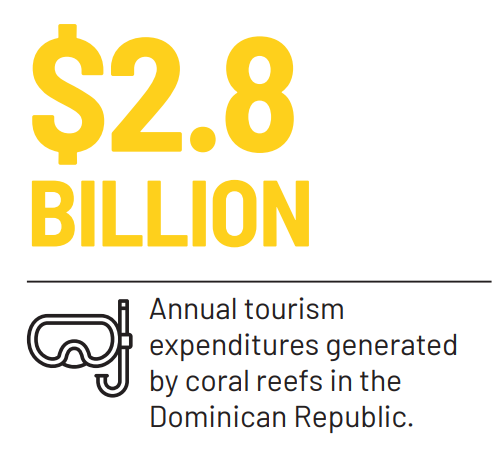
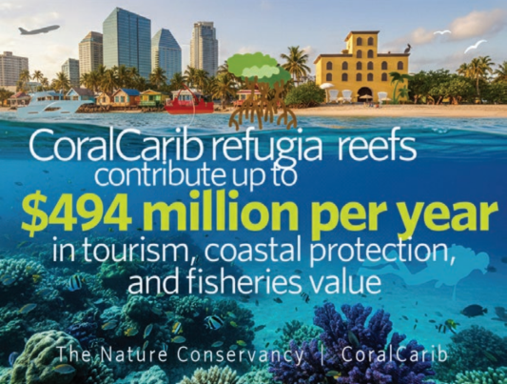
The results show that, at a national level, coral reefs drive up to $2.8 billion per year in tourism expenditures in the Dominican Republic, $689 million/year in Cuba, $670 million/year in Jamaica, and $61 million/year in Haiti. Zooming in to the refugia reef sites and combining with coastal protection models and fisheries surveys, the team found that CoralCarib refugia reefs in Cuba (Ciénaga de Zapata MPA and Havana), Dominican Republic (Bayahibe and Punta Cana), Haiti (Baradéres-Cayemites MPA) and Jamaica (East Portland Fish Sanctuary) contribute up to $494 million per year in ecosystem services value (53% coastal protection, 41% tourism, 6% fisheries). These data will support these countries in ongoing and future coral reef conservation planning and make a strong economic case for coral conservation in the Caribbean.